Anúncios
You’ve just passed your driving test. Congratulations! This is a huge achievement, but the next steps are crucial.
This guide explains exactly how to get your first full UK driving licence. We’ll cover everything you need to know to get on the road legally and safely.
Let’s get this sorted so you can start driving with confidence.
Can I Drive Straight Away After Passing My Test?
Yes, you can! The great news is you don’t have to wait for your photocard licence to arrive in the post.
Your examiner will give you a driving test pass certificate. This document is your temporary proof of qualification to drive.
However, before you even think about turning the key, there are three legal must-dos. Your car must be properly insured, taxed, and have a valid MOT.
Driving without the right insurance is illegal, even if you just passed. Don’t get caught out on day one.
Here’s your immediate checklist:
- Update Your Insurance: Call your insurer immediately. You must switch from a “learner” policy to a “full licence holder” policy. This is not optional.
- Check Your Vehicle Tax: Ensure the car you’re driving has valid road tax. You can check its status instantly on the GOV.UK website.
- Confirm the MOT: If the car is over three years old, it must have a current MOT certificate. Driving without one is illegal and unsafe.
Getting Your Full Driving Licence: The Automatic Process
For most people, getting your new licence is simple and automatic. You won’t have to fill out any extra forms.
At the end of your test, the examiner will take your provisional photocard licence. They’ll ask if you want your full licence sent to you automatically.
By saying “yes,” you authorise them to arrange everything with the Driver and Vehicle Licensing Agency (DVLA).
Your new full photocard licence should arrive by post at your registered address within three weeks.
If it hasn’t turned up after three weeks, don’t just wait and hope. It’s time to contact the DVLA directly to find out what’s causing the delay.
When You Must Apply for Your Licence Manually
Sometimes, the automatic process isn’t possible. You’ll need to apply for your licence yourself in a few specific situations.
This is your responsibility, and there’s a strict deadline, so it’s vital to know if this applies to you.
You must apply manually if:
- Your personal details (like your name or address) have changed since your provisional was issued.
- You didn’t give your provisional photocard to the examiner, perhaps because you needed it for ID.
- You still have an old-style paper provisional licence, which was issued before photocard licences were introduced in 1998.
How to Apply for Your Licence: A Step-by-Step Guide
If you need to apply manually, the process is straightforward but requires careful attention to detail.
Here’s exactly what you need to do:
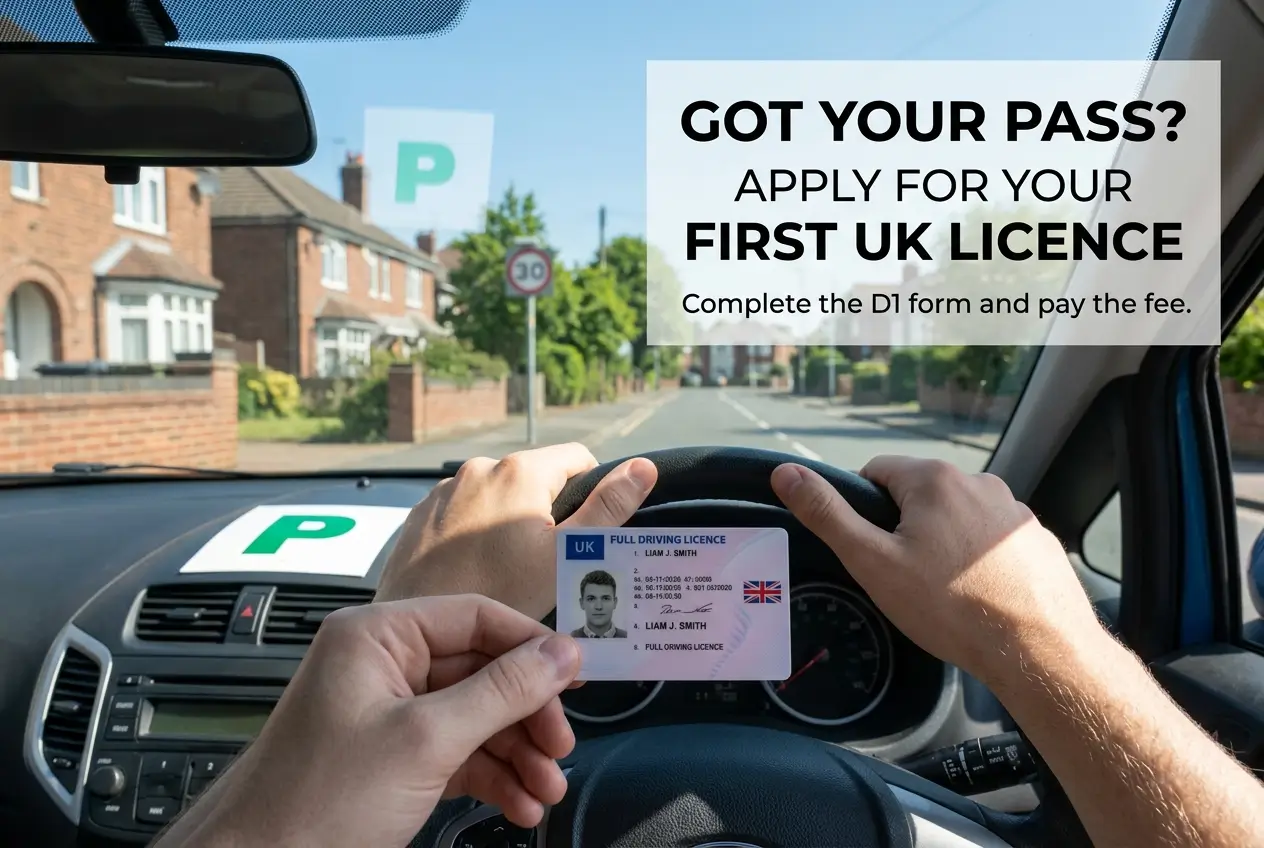
- Get the D1 Form: You need an “Application for a driving licence” form, known as a D1. You can pick one up from most Post Office branches.
- Gather Your Documents: You will need to send your original documents. This includes your test pass certificate and your provisional licence.
- Include Proof of Identity: If your name has changed, you must also include the relevant official documents, like a marriage certificate or deed poll.
- Send Everything to the DVLA: Post your completed D1 form and all required documents to the official address: DVLA, Swansea, SA99 1BN.
Critical Deadline: You have two years from the date you passed your test to apply. If you miss this deadline, your pass certificate expires. You will have to pay for and pass both the theory and practical tests again.
Important Advice for New Drivers
Now that you’ve passed, the ‘L-plates’ must come off your car. It is illegal to drive with them on after you have a full licence.
Some new drivers choose to display green ‘P-plates’ (for ‘probationary’). This is completely optional.
They simply signal to other road users that you’re new to driving alone, which might make them a little more patient.
Passing your test is a brilliant start, but it’s really just the beginning of your driving journey. True confidence comes with experience.
Consider taking extra training to build your skills. The Pass Plus course is a popular option designed by the DVSA.
It helps new drivers gain experience in areas that aren’t part of the test, such as:
- Motorway Driving: Learning to handle high speeds, lane discipline, and joining or leaving motorways safely.
- Night Driving: Coping with dazzle, judging speeds and distances in the dark, and using your lights correctly.
- All-Weather Conditions: Gaining skills for driving in heavy rain, fog, snow, or icy conditions.
- Driving in Town: Dealing with complex junctions, trams, and bus and cycle lanes.
Completing Pass Plus can sometimes lead to a discount on your car insurance, so it’s worth checking with your provider.
⚠️ Critical Scam Warning: Protect Your Licence and Identity
Sadly, new drivers are often targeted by sophisticated scams. You must be extremely careful where you share your personal information.
Scammers use professional-looking websites and social media adverts on TikTok, Instagram, and Facebook.
They promise to “fast-track” your licence application for a fee or even sell you a “guaranteed pass” without a test. These are always fraudulent.
Remember these golden rules:
- Only Use GOV.UK: The only place to deal with the DVLA or DVSA online is the official GOV.UK website.
- Never Use Third-Party Sites: Any site that asks for money to “help” with your licence application is a scam.
- Never Pay via Bank Transfer: Fraudsters will ask for direct payments. Official government services will never do this.
The consequences are incredibly serious. Using a fake or fraudulently obtained licence can lead to a prison sentence of up to 10 years.
You will also lose your money and expose yourself to identity theft. It is simply not worth the risk.
Useful Contacts and Official Resources
When in doubt, always go directly to the source. Official channels are there to help you and provide accurate information.
Keep these links handy if you run into any issues:
- DVLA Enquiries: For any questions about your licence application or if it hasn’t arrived, use the official contact page at gov.uk/contact-the-dvla.
- Report Fraud: If you see a suspicious website or social media advert, report it immediately to Action Fraud, the UK’s national centre for fraud reporting.
Enjoy your new freedom on the road. Drive safely, stay vigilant, and always use the official GOV.UK website for any driving-related services.